Showing posts with label Leipzig. Show all posts

Thursday, 7 June 2012

Days 7- 11 Leipzig and Colditz


It might sound daft but, despite the fact I have an InterRail pass, I buy a ticket from Chemnitz to Leipzig. With my pass, I can travel on 10 days within a three week window. But I didn't want to use up one of the days for just a €14.50 fare. Of course, if I end up not using all of the days, it's a false economy.


Leipzig Station is amazing, it is said to be one of the biggest termini in Europe, reflecting the city's past prominence in trade fairs. It's the sort of place where one is happy to linger, especially as there are some 1940's German locomotives on display. So I do.
My hotel for my first night is directly across from the station. But, while the location is excellent, I can't recommend it. The Seaside Park is, to my mind, pretty soulless, just another Euro-standard hotel. Staff do their jobs but I didn't find anyone going out of their way to be especially friendly or helpful. However, my view may be coloured by their late check out policy, which levies a €10 per hour charge; their parsimonious one hour free internet (slow connection) for guests, after which you have to pay extortionate rates as well as one staff member who decided to close the railway carriage section of the restaurant 45 minutes before the end of breakfast service.


They could take a leaf out of the book of the staff at the Balance Hotel, Alta Messe. Without exception, everyone was bright, cheerful, helpful and willing to please. It's fifteen minutes out of the centre by tram, but they give you a free transport pass for the duration of your stay. Set in a really nice residential district, there are plenty of places to eat and drink at substantially lower cost than the city centre. As an example of their willingness to please, they arranged for housekeeping to clean my room while I was at breakfast, so I could work immediately afterwards and brought an iron and board to my room at exactly the time it had been requested. Gold star, especially for staff attitude and training. But it is also worth mentioning that the breakfasts were excellent,in a nice bright room, the room was really spacious and there is unlimited free internet.
If you are a classical music buff, Leipzig will of especially of interest. Bach, Wagner, Greig, Mendelssohn and a whole host of others have lived and worked here and there are museums, concerts and a huge variety of other attractions related to those with a musical interest.
My own view is that they push that aspect of the city a bit too hard, because there is much else of interest.
With no frills carriers such as Ryanair offering direct flights to Leipzig, it's no wonder that this former East German City is seeing its tourism numbers increase dramatically.
Apart from anything, Saxony is one of the cheaper parts of Germany to stay, eat and drink. Prices will no doubt increase but, at the moment, it's good value.


It takes only moments to discover that Leipzig has some really impressive architecture and, since reunification, there has been much done to spruce it up., Much, though remains to be done and construction work is ongoing everywhere. But it doesn't take long to discover that there are many abandoned buildings awaiting their fate.


Much as I am a fan of promoting tourism, whoever agreed to place advertising banners on this clock tower? Surely an extraordinarily insensitive decision?


The Nikolai Church is beautiful inside. You are not supposed to take photographs (for what reason, I really have no idea, but officials constantly wave cards at you reminding you of the ruling). So here are a couple of shots I smuggled out.


There is no such petty nonsense in Thomas Kirche, so I could take a photograph of a choir from Biggleswade without incurring the wrath of officialdom. But the church is pretty plain by comparison with the grandeur and gilt of Nikolai.


Public transport in Leipzig is a joy. Trams and buses criss cross the entire area, most running every 10 or 15 minutes during the day. At €34 for 3 days, a Leipzig Card gives you unlimited use of the network plus discounts to many attractions. But as my hotel had already given me a pass for the transport, I am not convinced of the value of the Leipzig Card, especially as it is more about discounted entry than free. It is also worth mentioning that a day pass for the central transport zone is just €5.


In any case, museums such as the 'Runde Ecke', set in the former State Security regional HQ, are free of charge. It is fascinating to see just what lengths the STASI went to in order to control the locals. The secret cameras, the card indexes, the bugging devices. One very poignant exhibit is an essay from a 14 year old schoolboy who, in 1989, openly criticised the regime. The document was sent to the STASI, who started trying to exert influence on the boy's family. Luckily, before too much could happen, the Berlin Wall came down and the regime was at an end.


Also on show is a machine used to pulp documentation which people-power brought to an end long before all the evidence of the STASI's activities could be destroyed.


Leipzig Zoo is not far from the city centre and is well worth a visit. Especially since its tropical dome was opened in 2011. I have never seen anything quite like it in a zoo; it's like having a jungle inside a CenterParcs sports complex . You can either take a boat trip for €1.50, or walk around the hot and steamy jungle setting looking for a whole host of animals.


The zoo itself is world-renowned, with animals such as lions, tigers, apes, giraffe and elephants all housed in spacious enclosures, designed to offer maximum access to visitors.
Just a couple of thoughts, the inside of the dome is very hot and humid, so dress appropriately. And the zoo covers a big area, so wear good shoes for walking and be prepared to spend a whole day there.


Another day trip from Leipzig is to Colditz Castle, the famous prison camp for Allied officers during World War 2. I say that, but it's not at all well known to Germans! I enquired at Leipzig Tourist Information Office about getting there, to be told that 'it was difficult, with only one bus a day'. That may have been the case in the past, but it is, these days, pretty easy to reach Colditz by public transport. Bus 690 leaves the east side of Leipzig main station almost hourly during the day; the service returns from Colditz just as regularly. It is also easy to get to the castle by taking the train from Leipzig to several stations including Bad Lausick and Grimma, from where regular buses link to Colditz. German Railways information counters will provide both bus and train times and connections.


It cost me just €5 for the 85 minute trip, although travelling on an unmade road in a bus was one of the more interesting moments of the trip!
The first sight of the castle is from the attractive market place in Colditz. I had done my homework, so knew that the Saxony Government have painted the once grey and forbidding castle white, but the Welsh couple who'd travelled on the bus with me needed some convincing they had come to the right place.
The outer courtyard, former accommodation to the Camp Commandant and Officers, has been refurbished into a youth hostel, with a lot more work underway.


The inner courtyard, which housed the British, French, Dutch and Polish prisoners, is largely untouched.
You can take a short tour, but I heartily recommend the two hour trips led by Steffi Schubert, who comes from the nearby town of Grimma. For €15, Steffi, armed with a huge bunch of keys. will take you on a real insider's trip, show you the cellar from where Major Pat Reid escaped, the route taken by the first escapee Airey Neave, the chapel, theatre, tunnel entrances and exits, the park and a whole lot more.


As a very special treat, she managed to persuade the caretaker to allow her to take me to the attic room, where prisoners built a glider just before the end of the war. Channel 4 have recently rebuilt a full-sized replica of the aircraft and actually flew it from the roof to prove whether it would have flown. The programme is due to be aired on the channel in summer 2012.
The castle authorities are hoping to put the glider back together again after its crash landing (in which the dummy pilot was decapitated) and to make the room accessible to tour groups in the future.
As a boy brought up with Pat Reid's 'The Colditz Story' and the BBC series 'Colditz', a visit to the Castle was truly memorable. A lot of it, especially the chapel, is in a dreadful state, but the regional Government is doing what it can to bring it back to life. There have been worries that their enthusiasm for refurbishing will destroy much of WW2 significance, but I am told that they are now much more aware of the need to conserve than they were. 

Sadly, prisoners' graffiti from the 1940's has all been painted over, but you can still see photos of it in the excellent little museum, which includes amazing exhibits such as a home made wooden sewing machine, used by prisoners to make escape uniforms.


Colditz as a town is a pretty little place, with a newly-opened tourist information office. As with much of the former East Germany, it still has a lot to learn about what tourists expect, but at least they recognise the enormous potential that undoubtedly exists.


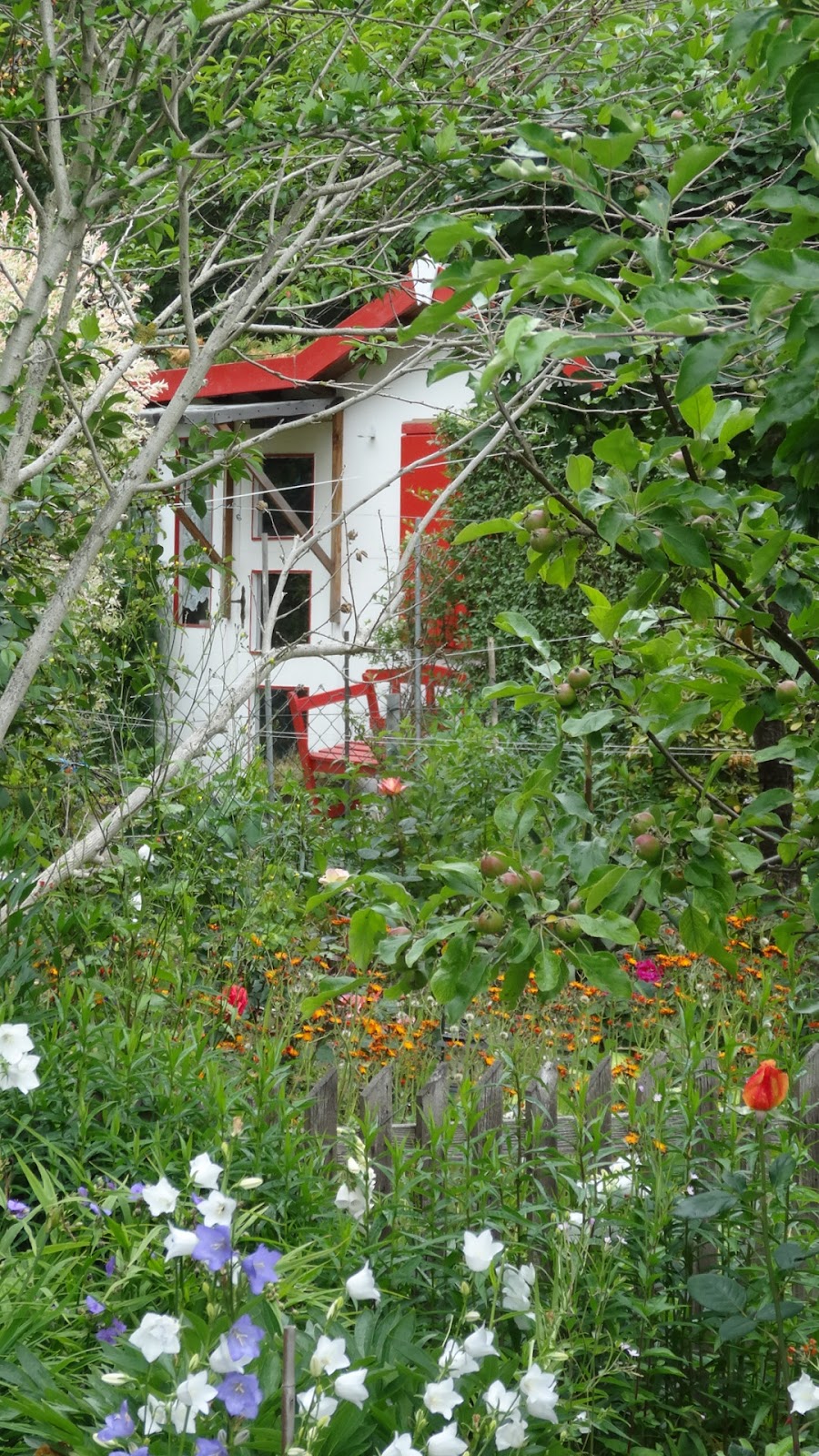
Back in Leipzig, an interesting and unusual visit is to see the German allotment museum which sits in the middle of one of the city's 211 such sites. The museum itself is interesting, but everything is in German. Perhaps of more interest are the 156 allotments, for which owners pay just 150 Euros for a plot of between 100 and 300 square metres. One plot has been in the same family for 70 years.
All of the allotments have huts which come in all shapes and sizes and are complete with running water and electricity. Caterina Hildebrand, who runs the museum, told me that people can stay overnight in their huts, but they are not allowed to have their post delivered!
The allotment movement is huge in Germany, with around one million people having one. In Leipzig alone, there are over 200 sites involving some 33000 plots.
The 'Kleingartner Museum' is open from Tuesdays until Thursdays from 10 till 4.
There's a really nice looking pub-restaurant in the same building as the museum but, somewhat bizarrely, it only opens at 4pm midweek.
My final port of call in Leipzig was to the Thomas Kirche, celebrating its 800th anniversary in 2012, where I had been invited to the Bach Festival opening concert. 


The place is packed for the event, which includes the church's school choir, the city's university choir and Leipzig's famous Gewandhaus Orchestra.
Impressive stuff in a city which has surprised and delighted me. Leipzig and this part of Saxony has been great and, in four days in the city, I know I have just scratched the surface.
With all the construction work going on, the next time I am here, I know it will be very different and prices will undoubtedly be a lot higher. So my advice?
Come as soon as you can.
Tomorrow I get back on the tracks for the long rail journey, via Frankfurt, to the Black Forest.

Here's a slide show of the trip photos:

Sunday, 3 June 2012

Day 6 Dieppe to Dresden, via Paris, Stuttgart, Frankfurt, Leipzig and Chemnitz

Ghislaine kindly drops me at Dieppe Station well in time to catch the 0801 train to Rouen. It's a bit early for breakfast, so I have popped out to the local boulangerie for some wonderfully buttery croissants to eat en route. The first attempt nearly ends in a delayed departure, when they decide to stop the traffic to open the bridge to let a fishing boat out.
As always, I have enjoyed Dieppe and one little booklet, 'A taste of Dieppe' has been especially useful. Produced by expat, Peter Avis, it's a really insightful guide to where to go in the local area. I have been using the 2011 edition; I very much hope they have the foresight and the budget to produce another.
There are clear signs in Dieppe that the area is feeling the financial squeeze, with many shops, restaurants and offices shuttered or on offer for sale or rent. I am sure the area will recover, because it really does have a lot to offer.


There are no problems on the first legs of the long train journey, although I am a bit disappointed that the Rouen to Paris sector is fulfilled by an old style loco and carriages. But it's quiet enough, except that, as we approach the French capital, dozens of folk pile through to the front of the train to save a few seconds in exiting. I stay put till they are out of the way.


My transit between Gare Saint Lazare and Gare de l'Est in Paris is easily achieved with one stop on the RER Line A and one stop on the metro (€1.70) , although there is a tricky moment when one of my trolley bags gets wedged between a closing ticket gate..
I have never felt totally comfortable on the RER; there always seems to be some scary looking people around. But it's mid-morning and things are pretty quiet.
I am, rather frustratingly, routed to Frankfurt via Stuttgart and try again to change it to the more direct option. But, just as I have found to be the case before, there are plenty of seats, just nothing available for InterRail pass holders.


The enormous train is made up of two 12-coach TGV's, which will separate in Strasbourg. We are served lunch which comes in a rather natty little box. Wine, beer and coffee too, with repeats on request. As I have paid a whopping 33€ supplement for the seat reservation, I feel justified in exercising my right!


At Frankfurt, the transfer between French TGV and German ICE is a matter of simply crossing the platform. The interior design of the German Railways; ICE high speed trains remain my favourite in Europe; all wood, stainless steel and glass, with each carriage having a mix of compartments and open seating. 


I enjoy a cup of English Breakfast Tea in the very quiet carriage. I ask if I can purchase the DB china mug. The girl tells me in perfect English that it's not possible, but later returns to present me with one 'as a gift from the staff'. It's a much appreciated gesture and will make a splendid souvenir of my trip. 


In Frankfurt, there's a bit of a dilemma. My train, the Interlaken to Berlin ICE;  is showing as departing from both platforms 8 and 9 at the same time. It's rush hour, the place is packed and I can't find any handy German Railways' staff to advise me. So I gamble and, luckily, as soon as I board, find a handy German Railways' travel guide, to show me that I am on the right train. But I never did manage to find out exactly what was going on.
I have decided to break the journey at a town called Fulda, simply because ten hours is enough travelling for one day.
I am booked into the Hotel Peterchens Mondfahrt, only five minutes by taxi from the station. But it appears that my request for a big bed doesn't compute in Germany and I am shown to a room with two singles. They later find two beds pushed together, but still with two single duvets. It  transpires that a big bed and duvet is not at all common in smaller German hotels.
The hotel owner recommends the Alte Pfandhausstube restaurant, where I enjoy some hearty German soup and the almost obligatory meat and two veg main course, washed down with a beer. Pretty good value for just over €20.


I have already discovered that, this far east in Germany, there appears to be a great reluctance to embrace international tourism. Very little, even hotel and tourism websites,  is translated into English and the ability to speak any language other than German is rather lacking. I am surprised and disappointed by that and will explore the issue further when I meet with local tourism managers in Leipzig next week.


I only have the morning to explore Fulda, which is disappointing, because it turns out there is much to see. I especially enjoy the orangery, where the baroque ceiling is simply stunning. One of the staff tells me all about it in heavily American-accented English. It turns out she has spent a year on the US west coast. The cathedral is also pretty impressive with a great dome.


Back at the station, I have time to take advantage of their special offer of a cup of coffee and piece of strawberry-topped cake for just €3.33; very good too. 
I also have time to make some reservations for a day trip by train from Belleville-sur-Saone near Lyon in France, to Bern in Switzerland to get an emergency passport. . The 16-hour day breaks up my stay on a French vineyard and  is a long-day I could well do without. But it is a better option than having to cart all my luggage on the train to Bern at the end of my stay.


I am joining the Frankfurt to Dresden InterCity service, which turns out to be an old-style corridor train with compartments. Except that my reserved seat is in a busy passage stacked with luggage next to the Cafe Bar. Even worse, my seat is occupied by a German businessman who shows no interest at all in removing either himself or his bag.
So I opt to join an elderly couple in a compartment, which is fine, except they have the heating turned up full, so I swelter for nearly three hours.


More about Leipzig when I return on Monday, but the station is yet another German Railways' temple to the train. It looks stunning and I am very much looking forward to my time in the city next week.


I am surprised that the little train to Chemnitz actually has First Class seating, but, to be fair, it's no different from that in steerage. Except that it is rush hour; second class is standing room only, while everyone in the front cabin has two seats each.
I like the fact that I can see through the driver's cab to the line ahead, which I used to love when travelling to Glasgow in the old diesel multiple units of my childhood.
At Chemnitz station, my German friend Johannes greets me on the platform; his primary school teacher mother, Ina,  is waiting in her car to take me to my lodgings. I am glad he is with me, because everything at the little pension has no English translation. My room at the Art Nouveau pension is simply furnished, but spotlessly clean. I remark at the low cost of just over €30 a night, including breakfast, to which Johannes replies that prices in the area are about the cheapest in all of Germany 

He is studying chemistry at the prestigious Chemnitz Technical University and proudly shows his mum and I around the lecture rooms and other areas that affect his student life.


We head for dinner at the Turm Brauhaus, which, much to my delight, brews its own beer. The food is good hearty German fare and we have a splendid evening. So much so that Johannes' mum decides to spend an extra night in town and take us all to Dresden, the capital of Saxony, for the day.
It's less than an hour by car from Chemnitz to Dresden on one of Germany's horrifyingly fast autobahns. It doesn't take us long, once we have escaped from taking the wrong turn on foot up an emergency staircase, to find ourselves surrounded by simply stunning Baroque-style architecture. But it's almost all new, having been rebuilt after the city was reduced to rubble by bombing raids by the American and British air forces during World War 2.


Of course, such stunning surroundings means that the city is full of horribly large tour groups being dragged around by umbrella-wielding guides. Not my cup of tea at all and clearly not of many of the tourists who look utterly bored by the whole experience.
We see the main sights and then discover from a couple of costumed characters who pass by, that a Baroque Festival is being held in nearby square.


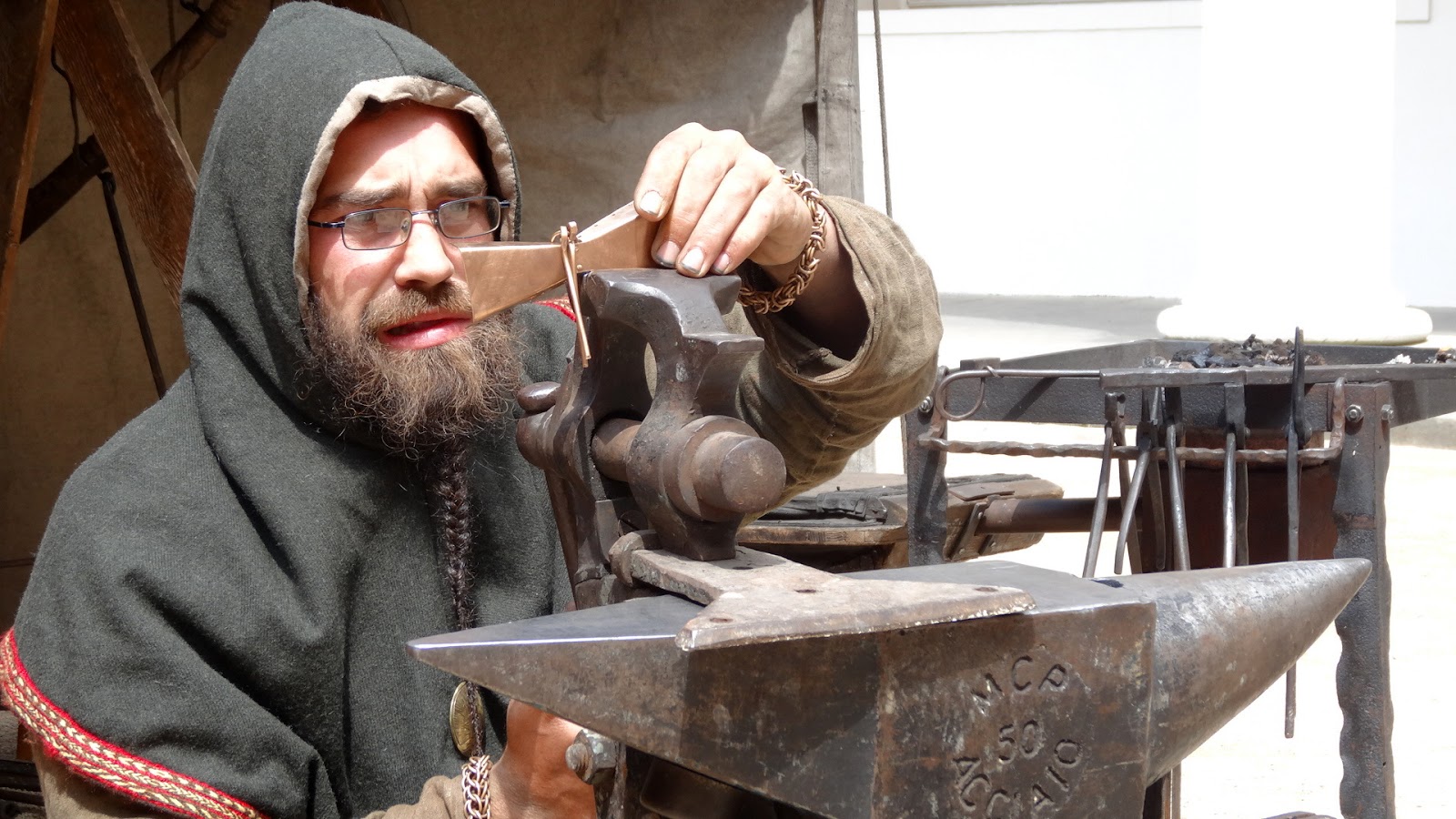
This turns out to be an absolute delight, with many people dressed up and fully participating in the atmosphere of the day. We enjoy all sorts of fruit beers and wines and typical German dishes. One is a sort of pizza called Flammkuchen, traditionally made in a wood-fired oven. We especially enjoyed  Spaetzle, which is little pieces of pasta mixed with ham, mushrooms and cheese.   There's a blacksmith working on an anvil, a carpenter making splendid chairs from German oak and a lady selling very expensive hand made brushes. 

I manage to excel at shooting a crossbow at a pretend apple target, hitting the bullseye on three occasions, with one of my other two arrows a near miss. Johannes recorded Scotland's success for posterity.
There are sadly far too few people at the event, some of the participants tell us because the organisers decided to charge a €5 entry fee. I am sad for all the people taking part, because the costumes and the atmosphere of the event are absolutely stunning.
So much do we enjoy the Baroque Festival, that we spend over three hours inside and by the time we exit, Dresden is not nearly so tourist infested as it had been.


We stroll across a splendid bridge to the other side of the Elbe to enjoy a beer while watching folk pass by in front of Dresden's stunning backdrop.
The town lost its much sought after UNESCO World Heritage Status when it was decided to built a monstrous bridge only two kilometres from the centre. An astonishing decision, by all accounts which made the city only the second place ever in the world to be stripped of its heritage status.
In the evening we have a home-cooked meal and Ina bids us farewell as she sets off in the morning for her six hour drive home.
It’s not a day for sightseeing on my final day in Chemnitz as it's pouring down with rain, but the Baedeker guide indicates  I have pretty much seen all there really is to see.


There are parts of the town which have changed out of all recognition since reunification, but others which still resemble the old East Germany. The old two-stroke Trabants are still quite common and there is clearly much to do before the area recovers fully from the many years of under investment.
There is still much in evidence of the old regime, when the town was called Karl Marx Stadt; that, possibly, is one of my biggest surprises.
Most hotels in Chemnitz offer free local transport as part of the package, not something that, as far as I am aware, was offered by my pension. But a day ticket for the buses and trams is only €3.80 for me, so we decide to take a tram into town to take Sunday lunch at the RatsKeller.
The food is fine and the cellar itself has a great feel. But both Johannes and I agree that the choice of music, which we learn is decided by the chef-proprietor, is absolutely wrong. He has gone for a peculiar mix of Europop meets country, quite inappropriate for both the general age of the clientèle and the historic setting.
We are served by a fairly frosty Frau, who, after our main course is served, seems more keen to get the tables relaid and to get home, than looking after any clients who might want more drinks and pudding. 

When dessert, after a long delay, does appear, it is well presented but let down by microwaved apfelstrudel. Five minutes in a  hot oven, surely chef Dirk?
Johannes and I agree that quality and price of the meal was OK, but the service and atmosphere at the TurmBrauhaus across the road was a lot better.
Tomorrow, the short hop to Leipzig for the InterRail conference, followed by three more days exploring what I am told is a delightful city.
Let's hope the weather improves.

Photos of the rail trip are all at:


European Rail Trip 2012